Begin the Year With Thanks
The bottom line first: your handwritten thank-you note will be remembered simply because you sent it.
Handwritten thank-you notes have become uncommon and are easy to overlook in a digital-first world. Many send quick emails of thanks. Some people still intend to send a handwritten one. Very few actually do. In a world of quick replies, reaction emojis, and “circling back,” taking the time to write and mail a real note already sets you apart.
That alone matters.
In December, I donated to an Omaha-area nonprofit and received four thank-you notes before the end of the year, including:
A formal typed thank you letter and gift acknowledgement from the board chair
Handwritten notes from
the CEO
the incoming board chair
the CFO
This is extraordinary donor relations. I share the example not because multiple notes are required, but because the organization’s response to my gift, even a modest one, will stay with me. I felt valued, and it reflected a culture that respects relationships, not just transactions. Even if your organization sends an automatically generated CRM email response, an additional personal note is wise.
It’s worth asking: as a professional, what does your personal approach to gratitude look like? What is your organization’s approach?
But if you want your note to be remembered for more than just its existence, utilizing business writing fundamentals goes a long way. Here’s how to make sure your gratitude lands exactly as you intend.
1. Spell. Everything. Correctly.
This is non-negotiable. Double-check:
The person’s name
The organization’s name
Titles
Street name
A thank-you note with a misspelled name does more harm than good.
Use various editing lenses:
Read it once for content clarity.
Read it again for spelling and grammar.
Then read it a third time for names and proper nouns.
My former Meet the Press colleague Betsy Fischer Martin would throw away any mail sent to her with “Betsy” or “Fischer” spelled wrong. Straight to the trash! You should assume everyone has that rule.
2. Paper Quality
It doesn’t matter what card or paper you use, as long as it isn’t unintentionally offensive or wildly off-brand.
A few guardrails:
If you’re writing on behalf of a nonprofit, skip ultra-luxury stationery that feels indulgent.
If you’re writing to someone with refined tastes, choose something simple and high-quality. Perhaps select a card with an illustration that connects to something they care about, a place they love, or a shared interest. Even better, use your organization’s notecards.
Collect cards from local hometown shops for your “stationery box.” (See #5)
A friend from the South once told me: Never send a thank you card that already says “Thank You” on the front. Take that advice or leave it. If that’s what you have, send it. The note matters more than the style suggestion.
3. Use a proper salutation and give it space
Start with a greeting. Then start your first sentence below the salutation, not beside it like it’s a text message.
Be careful how you address the person. Are they a medical or academic doctor? Are they married? Can you call them by their first name?
If you don’t know, do some digging online, ask a colleague, or call the main line at the person’s place of employment and ask.
4. Be specific
“Thank you for your time” is polite. It’s also forgettable unless you add the specifics!
Instead:
Say why you’re thanking them
Share how you’ll use the gift, advice, or insight
Name one specific reason their time or generosity mattered to you
Can you safely make them laugh? Or feel some emotion?
Specificity is what turns courtesy into connection. It tells the reader: I noticed. I paid attention. This mattered.
Even with all these details, the note doesn’t have to be long. And, if you have terrible handwriting like me, be sure to write clearly to ensure readability.
One cute exception to this rule is when I have received a thank you note from one of my nieces or nephews, and they write:
Dear Aunt Erin. I like my gift.
When it’s a child or young person writing, it’s even better if it’s all snug at the top of the card, diagonal with a crossed-out word, or centered in the middle of a large empty card. But for us adults, more detail and formatting is required.
5. Build your stationery box of supplies
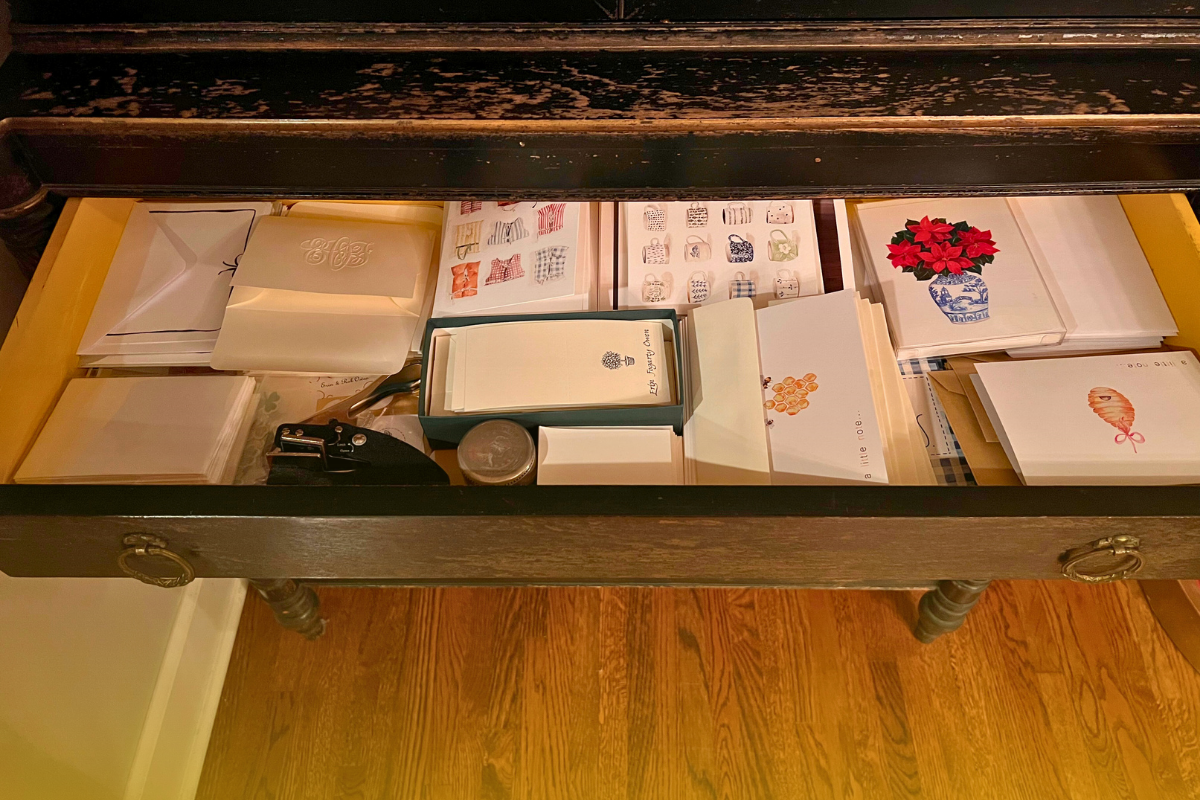
If you want to prioritize sending thank-you notes this year, remove every possible excuse not to. That starts with having what you need on hand: make sure you have a stationery box or drawer and fill it with handy supplies:
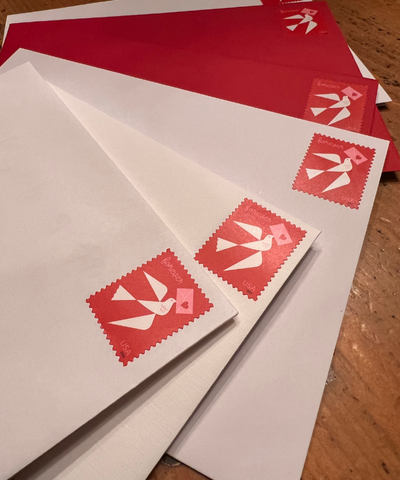
Stamps: This sounds small. It isn’t. Stamps carry tone. When in doubt, buy standard Forever stamps with a flag. They signal professionalism and neutrality. Avoid novelty stamps that can introduce unintended informality, politics, or confusion, especially in professional or leadership contexts.
Paper or cards: Collect middle-of-the-road paper or cards with matching envelopes or keep a small stack of neutral cards on hand. The easier it is to reach for supplies, the more likely you are to follow through in a timely way.
Pens: You know when a pen makes writing smoother and easier. Take note of the ones you enjoy using and buy them, so writing a thank-you note feels natural, not like a chore.
Start the year by leading with gratitude, professionalism, and human connection. In a culture that moves quickly, a well-written note will stand out.
When gratitude is specific and sincere, it honors a mentor, donor, or colleague and becomes part of your reputation.