Resource Hub for Strategic Communication Professionals
Looking for guidance? Explore our strategic communications topics in the categories dropdown below and use the search bar to quickly find relevant articles.

Analyzing the Xbox CEO’s Latest Announcement
Here’s a story about how listening to your users’ pain points, and the pain points of your competitors’ customers, can turn into great PR.
One of the biggest challenges of the digital age is ownership. Enter New Xbox CEO Asha Sharma.

25 Years After 9/11: What I Remember, What We Learned
Twenty-five years ago on Friday, I was asleep in my apartment on Capitol Hill while teams of terrorists were in the air overtaking four commercial airplanes. The United States was under attack, but most of us would not know that for sure until the second plane struck the World Trade Center.
At 8:46 a.m., American Airlines Flight 11 crashed into the North Tower. At first, it seemed possible it was a horrific aviation accident. Seventeen minutes later, at 9:03 a.m., United Airlines Flight 175 flew into the South Tower.
Between those two crashes, my boyfriend, Rob, called. “Turn on the TV. There’s been a plane accident in New York City.”

Good Good’s Bad, Bad Decision-Making
A 15-second social media ad has turned into a very expensive lesson in communications decision-making…Last week, Good Good posted an ad promoting its new driver with Callaway. In the video, co-founder Garrett Clark sees a woman reaching for the club, runs toward her, knocks her to the ground, stands over her, and tells her not to touch his new driver. It was apparently supposed to be funny.
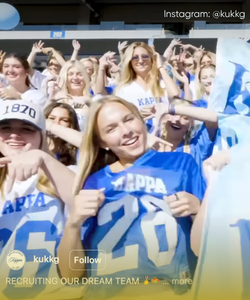
The Audience Got Bigger. Then Everything Else Did, Too.
When I went through recruitment at the University of Kansas (KU) in the fall of 1989, sorority recruitment was entirely analog.
The Panhellenic Association, the student leadership group that manages and governs recruitment (then called rush), produced, printed, and mailed a recruitment booklet. Prospective members requested a paper application (in writing or by a phone call), waited for it to arrive at home, filled it out, and mailed it back to KU.
And then we showed up…Then the technology started changing, and quickly.

What Pop Star Zara Larsson Can Teach Us About Branding
If you’re up to date on your pop princesses, you undoubtedly know Zara Larsson. If you're not, then come along on a ride on the back of a dolphin to learn about reinvigorating a brand through recognizing and incorporating social media trends.

Meet the Messenger: Jon-Stephen Stansel, Founder of Saturn 9 Media
In the communications field, few people understand social media as well as Jon-Stephen Stansel. A former English as a Second Language (ESL) Instructor at the University of Central Arkansas who fell into a social media career by embracing the very technology he once tried to keep out of his classroom, Stansel is an award-winning communicator with over 15 years of experience managing, building, and creating content for brand social media accounts.
As founder of Saturn 9 Media, he has worked on social media accounts for Amazon Prime's “Invincible” and “Hazbin Hotel” animated series, Hyper RPG, Better Place Forests, the University of Central Arkansas, Texas State University, the Texas Department of Transportation, as well as consulting for many television series, films, and small businesses.
As Director of Social Media for Chaotic Good studios, Jon-Stephen worked on social media strategy and content for “Avatar: The Way of the Water” and Amazon Prime Video’s “Lord of the Rings: The Rings of Power” among several other major entertainment franchises.
He’s also the author of “The 10 Principles of Effective Social Media Marketing,” a clear guide to mastering the fundamentals that work on any platform, in any trend cycle. (Keep reading to win a copy!)
In short, there's no one better to share their insights on social media, where the profession is headed, and the opportunities it can create. We're delighted to share our conversation with Jon-Stephen in this installment of Meet the Messenger.

You Might Be Assuming Too Much
As communicators, we're constantly chasing what's new. We think our audience only wants the newest announcement or update, but sometimes we forget that the people we're trying to reach don't have the same baseline knowledge that we do. What’s mundane for us is new information for them. Often, it isn’t – at least for a portion of your audience.
Sometimes the thing preventing someone from engaging isn't a lack of interest. It's a lack of the most basic information and the work it would require to learn it.

Election Safety From a Communications Pro Who Knows
Most Americans never see the work that happens behind an election. We cast our ballots, watch returns on election night, and move on. But when questions arise about election administration or election security, many of us are left trying to sort through competing claims without first understanding how the system actually works and how it is secured.
That's why we had this conversation with strategic communications pro Teresa Paulsen who works in the election systems field to ensure Americans have clear and accurate information.

Graphics Communicate, Too
Last week in Nebraska, another candidate threw his hat into the race for governor, joining Lynne Walz in trying to unseat Gov. Jim Pillen.
Former State Sen. Brett Lindstrom is taking the independent route, which means before Nebraskans can even decide whether to vote for him, he first has to qualify for the ballot. Anyone entering a statewide race this late already has an enormous communications challenge.
Unfortunately, the campaign made it just a little harder.
The initial campaign graphic featured a stylized outline of Nebraska...except it accidentally lopped off southeast Nebraska.

Sadly, Scammers Must Also Be Good Communicators
Ugh. Your EO Report authors have been absolutely inundated with scams in our inboxes, texts, and voicemails this week.
How? Unclear. But however it happened, we're duly annoyed. Luckily, we've each sat through the University of Nebraska at Omaha's required employee cybersecurity training about a thousand times, so anyone with nefarious intentions is going to have to wake up earlier to catch us off guard.
But it got us thinking: scammers, perhaps more than anyone, have to be excellent communicators. After all, how else are they going to lure you into their trap without a convincing hook, voice, and call to action?

Out of Office. Still On Brand.
The Fourth of July is behind us, and vacation season is officially underway. Inboxes everywhere are filling with out-of-office replies.
They run the gamut from polished and professional to playful and personal. Some are concise. Others read like a vacation itinerary, complete with lake plans, limited Wi-Fi, promises to "check in occasionally," and even accidental old details left over from the last holiday break.
Most organizations never think much about them. But they should.

Crisis Scenarios You Should Be Ready For
First responders train for all kinds of emergencies. They practice until their response becomes muscle memory. They hope many of those skills never need to be used, but if the moment comes, they want their actions to be second nature.
Communicators should approach crisis situations the same way: pre-plan, practice, and perform when the moment arrives.

I Like It. What Is It?
I love a good nutritional hack.
A few weeks ago, while browsing through my favorite news aggregator, the Drudge Report, I came across an advertisement for an iodine supplement. I haven’t seen that type of ad before.
It was an ad for J. Crow's Lugol's Solution.
The ad did exactly what it was supposed to do. It caught my attention. I clicked. And immediately, I was intrigued. It lured me in…But after spending several minutes exploring the website, I found myself asking a simple question:
What is it?

Calm in a Crisis: You Set the Tone
When an organizational crisis hits, tensions run high. You may be feeling stressed and overwhelmed yourself. But here's the most important thing to remember: As the communicator, your job is to set the tone.

Look at Your Leader’s LinkedIn
Whether they realize it or not, your organization's leader, and ultimately the entire leadership team, acts as an extension of the organization itself. For some companies and nonprofits, the CEO (or executive director, president, or whatever title they hold) is inextricably linked to the brand. Whether they have a big personality or operate behind the scenes, they're highly visible, influential in shaping perceptions, and serve as a public face for the organization.
As a strategic communicator, your job is to identify the channels you can influence and optimize. Your website and organizational social media accounts are obvious places to start, but there's one area that's often overlooked: your leader's personal social media presence.

Meet the Messenger: Dr. Gail F. Baker, Former SVP & Provost, University of San Diego
We’re excited to feature Gail F. Baker, former senior vice president and provost at the University of San Diego. A respected communications leader, educator, and scholar, Dr. Baker has built a career that spans higher education leadership, journalism, public relations, and academia. During her time at USD, she served as the university’s chief academic officer, working closely with academic leadership to guide strategy and institutional priorities. Before joining USD in 2017, she was the founding dean of the College of Communication, Fine Arts and Media at the University of Nebraska Omaha and held additional leadership roles at universities across the country.
Dr. Baker’s career reflects a deep commitment to communication, leadership, and storytelling. Before transitioning into higher education administration, she worked in journalism and corporate communications, including positions with IBM and International Harvester, and as a reporter and editor for the Chicago Daily Defender Newspaper. An accomplished author and educator, she has written books, articles, and book chapters and has earned recognition for both her teaching and documentary writing, including multiple Emmy Awards for Excellence in Documentary Writing and Producing. We spoke with her about the experiences that shaped her leadership style, the evolving role of communication in higher education, and the lessons she’s carried across journalism, academia, and executive leadership.

L.T.A.A. (Let’s Talk About Acronyms)
Let’s talk about a common writing issue: acronyms.
In the communications world, they can save you some serious keystrokes, but they also give some important unspoken signals about who the writing is for.
So when should you use them, and when should you hold back? Just like an acronym, here’s some short guidance.

Do You Have a Defined Brand Voice?
You know when you hear an ad and can immediately tell who it’s from based on the language, tone, and music?
Or when you come across a social post that’s captivating less because of what it’s saying and more because of how it’s said and how it makes you feel?
Brands that have this figured out are clear on what their brand voice is.

The Power of “No, But…” in Communications Teams
How do you maintain a partnership mindset when your team is stretched thin?
One simple philosophy:
“No, but…”
Those two words, paired with clear processes and thoughtful alternatives, create flexibility. They allow communications teams to protect priorities and brand standards while still being helpful and collaborative.
Here’s what a “No, but…” philosophy can look like in practice.

How Does Your Customer Experience Every Touchpoint?
We often think of communications as messaging: campaigns, content, media. But the truth is that communication encompasses your customer’s entire experience and every touchpoint they have with you.
Even when those touchpoints don’t sit within your job description or the communications department, they shape perception. Which means they’re your business.
If you want to close the gap between what you say and what people experience, here are a few areas to look at.