Resource Hub for Strategic Communication Professionals
Looking for guidance? Explore our strategic communications topics in the categories dropdown below and use the search bar to quickly find relevant articles.

Good Good’s Bad, Bad Decision-Making
A 15-second social media ad has turned into a very expensive lesson in communications decision-making…Last week, Good Good posted an ad promoting its new driver with Callaway. In the video, co-founder Garrett Clark sees a woman reaching for the club, runs toward her, knocks her to the ground, stands over her, and tells her not to touch his new driver. It was apparently supposed to be funny.

What Pop Star Zara Larsson Can Teach Us About Branding
If you’re up to date on your pop princesses, you undoubtedly know Zara Larsson. If you're not, then come along on a ride on the back of a dolphin to learn about reinvigorating a brand through recognizing and incorporating social media trends.

Meet the Messenger: Jon-Stephen Stansel, Founder of Saturn 9 Media
In the communications field, few people understand social media as well as Jon-Stephen Stansel. A former English as a Second Language (ESL) Instructor at the University of Central Arkansas who fell into a social media career by embracing the very technology he once tried to keep out of his classroom, Stansel is an award-winning communicator with over 15 years of experience managing, building, and creating content for brand social media accounts.
As founder of Saturn 9 Media, he has worked on social media accounts for Amazon Prime's “Invincible” and “Hazbin Hotel” animated series, Hyper RPG, Better Place Forests, the University of Central Arkansas, Texas State University, the Texas Department of Transportation, as well as consulting for many television series, films, and small businesses.
As Director of Social Media for Chaotic Good studios, Jon-Stephen worked on social media strategy and content for “Avatar: The Way of the Water” and Amazon Prime Video’s “Lord of the Rings: The Rings of Power” among several other major entertainment franchises.
He’s also the author of “The 10 Principles of Effective Social Media Marketing,” a clear guide to mastering the fundamentals that work on any platform, in any trend cycle. (Keep reading to win a copy!)
In short, there's no one better to share their insights on social media, where the profession is headed, and the opportunities it can create. We're delighted to share our conversation with Jon-Stephen in this installment of Meet the Messenger.

Graphics Communicate, Too
Last week in Nebraska, another candidate threw his hat into the race for governor, joining Lynne Walz in trying to unseat Gov. Jim Pillen.
Former State Sen. Brett Lindstrom is taking the independent route, which means before Nebraskans can even decide whether to vote for him, he first has to qualify for the ballot. Anyone entering a statewide race this late already has an enormous communications challenge.
Unfortunately, the campaign made it just a little harder.
The initial campaign graphic featured a stylized outline of Nebraska...except it accidentally lopped off southeast Nebraska.

Out of Office. Still On Brand.
The Fourth of July is behind us, and vacation season is officially underway. Inboxes everywhere are filling with out-of-office replies.
They run the gamut from polished and professional to playful and personal. Some are concise. Others read like a vacation itinerary, complete with lake plans, limited Wi-Fi, promises to "check in occasionally," and even accidental old details left over from the last holiday break.
Most organizations never think much about them. But they should.

I Like It. What Is It?
I love a good nutritional hack.
A few weeks ago, while browsing through my favorite news aggregator, the Drudge Report, I came across an advertisement for an iodine supplement. I haven’t seen that type of ad before.
It was an ad for J. Crow's Lugol's Solution.
The ad did exactly what it was supposed to do. It caught my attention. I clicked. And immediately, I was intrigued. It lured me in…But after spending several minutes exploring the website, I found myself asking a simple question:
What is it?

Look at Your Leader’s LinkedIn
Whether they realize it or not, your organization's leader, and ultimately the entire leadership team, acts as an extension of the organization itself. For some companies and nonprofits, the CEO (or executive director, president, or whatever title they hold) is inextricably linked to the brand. Whether they have a big personality or operate behind the scenes, they're highly visible, influential in shaping perceptions, and serve as a public face for the organization.
As a strategic communicator, your job is to identify the channels you can influence and optimize. Your website and organizational social media accounts are obvious places to start, but there's one area that's often overlooked: your leader's personal social media presence.

Do You Have a Defined Brand Voice?
You know when you hear an ad and can immediately tell who it’s from based on the language, tone, and music?
Or when you come across a social post that’s captivating less because of what it’s saying and more because of how it’s said and how it makes you feel?
Brands that have this figured out are clear on what their brand voice is.

The Power of “No, But…” in Communications Teams
How do you maintain a partnership mindset when your team is stretched thin?
One simple philosophy:
“No, but…”
Those two words, paired with clear processes and thoughtful alternatives, create flexibility. They allow communications teams to protect priorities and brand standards while still being helpful and collaborative.
Here’s what a “No, but…” philosophy can look like in practice.

How Does Your Customer Experience Every Touchpoint?
We often think of communications as messaging: campaigns, content, media. But the truth is that communication encompasses your customer’s entire experience and every touchpoint they have with you.
Even when those touchpoints don’t sit within your job description or the communications department, they shape perception. Which means they’re your business.
If you want to close the gap between what you say and what people experience, here are a few areas to look at.
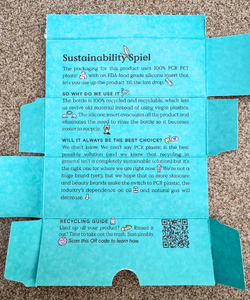
Use What You’ve Got
The other day, I received a new skincare product in the mail. It all felt standard until I opened the box.
The product box had a pull tab. As I followed it, the packaging unfolded (literally), revealing additional brand messaging tucked inside. What’s typically blank space became part of the experience.
It was unexpected, and, frankly, a fun experience. A boring, standard product box became a storytelling piece. It gave me a deeper understanding of the brand than I would have gotten otherwise. And it did it using space they already had.
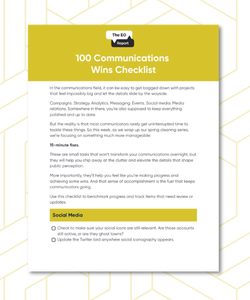
100 15-Minute Communications Wins (With Free Download)
This week, as we wrap up our spring cleaning series, we’re focusing on something manageable:
15-minute fixes.
Here’s a list of 100 wins you can quickly score for your communications work, complete with a free downloadable checklist.

Spring Cleaning Your Website
Last week, Nebraska, where The EO Report is headquartered, had some spring-like temperatures that had us jumping into spring cleaning mode. Admittedly, it was a little premature given the next day brought six inches of snow.
But that temporary sunshine did get us thinking about one spring cleaning area communicators often neglect until it becomes unwieldy and feels impossible to catch up with.
Your website.
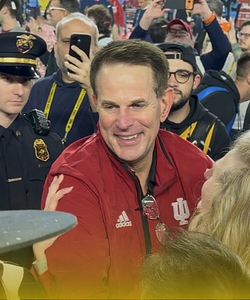
From Unknown to Unstoppable: What Strategic Comms Leaders Can Learn from Curt Cignetti’s Culture Reset
Two years ago, almost no one beyond football insiders had heard of Curt Cignetti. He wasn’t a household name, a blue-blood coach from the Power 5, or an up-and-coming assistant coach from last year’s championship team. Instead, he was quietly winning everywhere he went — at small programs that needed exactly what he built: belief, standards, and consistency.

What’s in a Name? Why Getting It Right Matters More Than You Think
In communications, a name is never just a label.
It’s the first story you tell. It’s the shorthand people use to understand who you are. And it’s often the difference between being recognized and being understood.
That distinction matters, especially for mission-driven organizations.
Earlier this year, Clarity Channels Communications (the home of The EO Report), had the privilege of working with Connected Roots Care Center (CRCC) on a rebrand that seemed simple on the outside, but had a major impact on their identity: it gave meaning to a name that already carried trust. The project received Nebraska Public Relation Society of America’s Paper Anvil Award of Excellence in Brand/Reputation management this past week, so we thought it was a great time to highlight the learnings from the project for all communicators.

Short Takes: The Turkey Talk-Line
Butterball, brilliantly, doesn’t just sell you a turkey: they give you all the tools to succeed from “how big of a bird should I get?” to “Why is it doing that!?”
Every year from Nov. 1 through Christmas Eve, 50 trained Turkey Talk-Line experts help more than 100,000 anxious cooks get dinner across the finish line. Phone, text, email, live chat – whatever has you panicking, they’ve got a channel for helping.

Find Your Niche: Spooky Lakes Month
When it comes to content, the temptation is to cast a wide net. Go broad, appeal to the masses, rack up followers. But those waters are crowded. The creators who stand out are the ones who pick a lane and stay there by offering something so specific that their audience can’t find it anywhere else. That’s where loyalty lives.
Take TikTok creator Geo Rutherford. She’s built an audience of 1.8 million followers around a single, unlikely niche: haunted hydrology.

Rebrand Regrets: What Cracker Barrel and Jaguar Teach Us About Change
You know the phrase, “if it ain’t broke, don’t fix it?” That old adage could have saved restaurant chain Cracker Barrel a world of trouble when it revealed plans to modernize its brand with a new logo and remodeled locations.
Cracker Barrel is known for its folksy feel and nostalgic décor. A little cheesy, yes, but intentionally so. But the new CEO, Julie Felss Masino, told investors that Cracker Barrel’s customer traffic had fallen 16% from pre-pandemic levels and admitted the brand was losing relevance, saying, “we are not leading in any area. We will change that.”
And change they did.

Short Takes: A Boat and a Brand Collab
If you’ve spent any length of time on the internet in the past few weeks, it’s likely you heard about the mega-viral video series about the 29-year-old man who quit his job, liquidated his 401k, bought a sailboat, and planned to sail from Oregon to Hawaii with his rescue cat and minimal experience sailing.
One savvy marketer from E.L.F., the cosmetics company, saw a brilliant opportunity to make a splash (pun totally intended).

The Rise—and Risk—of “Pity Marketing”
If you’re on TikTok or watching Reels on Instagram or Facebook, you’ve likely seen it. A lonely restaurant with empty tables. A book signing with no line. A warehouse full of unsold products. The voiceover is emotional and tugs at your heartstrings: “We’re really struggling—can you help?”
This is pity marketing, which can also be called “sympathy marketing” or perhaps more accurately, “emotional blackmail.”