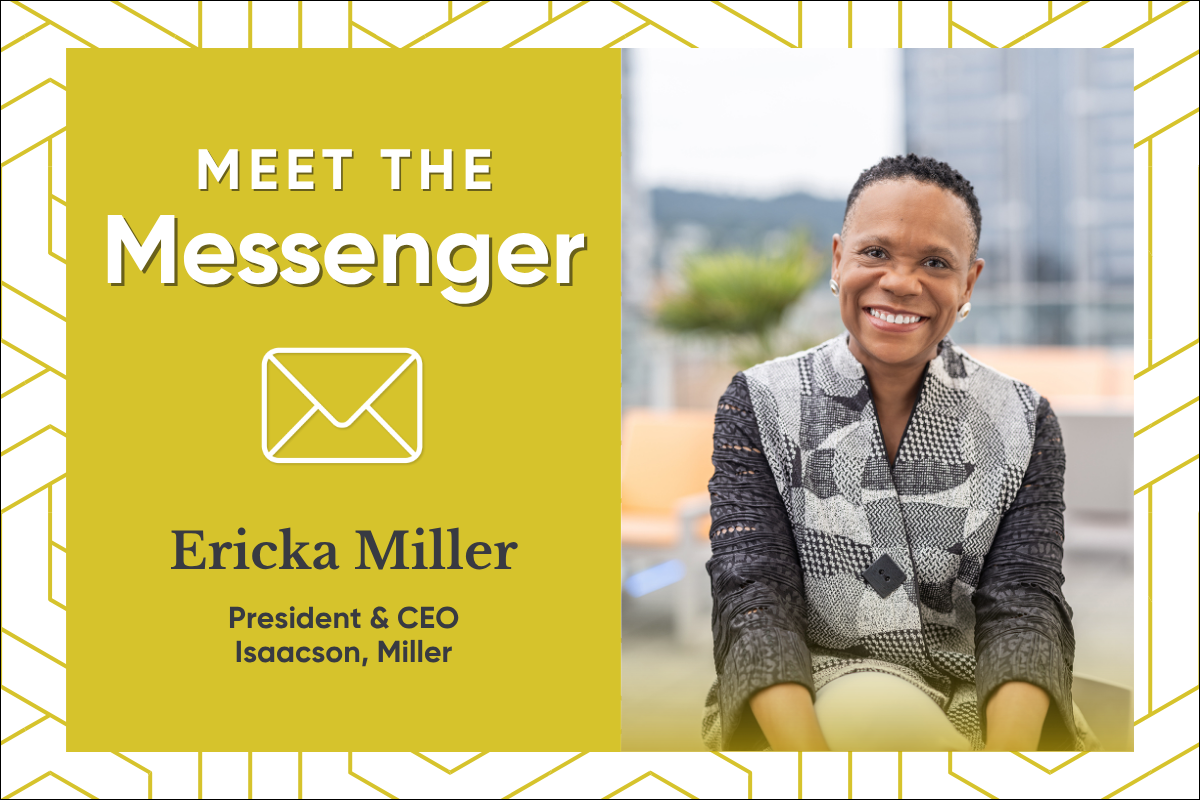
Meet the Messenger: Ericka Miller, President & CEO of Isaacson, Miller
Meet the Messenger spotlights leaders across industries who understand that strategic communication is central to individual and organizational success. Each conversation shares hard-earned lessons, candid reflections, and insights on how thoughtful, strategic communication drives impact.
We’re excited to feature Ericka Miller, President and CEO of Isaacson, Miller, a leading national executive search firm. A strategic leader with deep roots in education, nonprofit leadership, and public service, Ericka brings a wide-ranging perspective shaped by roles across government, academia, and consulting. Since rejoining the firm in 2016, she has led its preK-12 education practice, joined the Executive Committee, and stepped into the CEO role in 2021, where she now guides firm strategy, operations, and growth.
Ericka’s career reflects a consistent focus on impact from advising the U.S. Secretary of Education and contributing to national policy, to leading operations at major education organizations and supporting mission-driven leadership searches across the country. With experience spanning Capitol Hill, the classroom, and the boardroom, she offers a thoughtful, systems-level view of leadership and talent. We spoke with her about the early debate-driven roots of her communication style, how she leads with clarity and purpose, and the lessons she’s learned that continue to shape her decisions and impact.
What’s one pivotal moment that most shaped the communicator you are today?
It's not a moment, but rather an experience. I grew up in a family that loved to argue — and by argue, I mean debate. My father was an attorney, and both of my brothers eventually became attorneys. My mother was an educator. I used to say that our dinner table was like "The McLaughlin Group," the popular news roundtable show in which political pundits would vigorously discuss issues of the day. At the dinner table I had to be quick and clear with my point because my brother was right on my heels ready to disprove my assertion. I had to listen carefully to what he was saying so that I knew when to make my move. It was all in good fun, but it was competitive. It was great intellectual training. My older brother was born to the challenge. He was a natural litigator. The day that he finally conceded my point in a debate remains one of my most meaningful accomplishments.
I don't think of myself as a competitive communicator, but I try to be a good listener, and I try to be crisp and clear when sharing my thoughts.
Describe one project or situation where you were absolutely at your best. What made it work so well?
Effective communication is a key component of effective leadership. You can have the most well-conceived data-informed strategy, but if the people who need to help you execute it don’t understand what the plan is, what it will achieve, and why it matters, you won't be successful.
I find that I'm communicating at my best when I proactively answer at least these four questions:
What is the challenge or problem we're trying to solve?
How does the proposed solution address the challenge?
How is the proposed solution consistent with our mission and values?
What role do I need you to play in helping us achieve success?
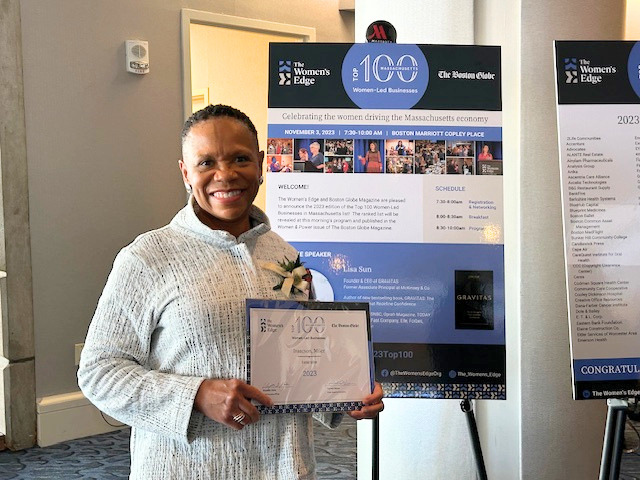
Ericka receiving The Women’s Edge and The Boston Globe for Best Women-Led Businesses in Massachusetts on behalf of Isaacson, Miller in 2023.
What’s a mistake you made that turned into one of your best professional assets?
The greatest asset that comes from making a mistake is wisdom, which is tremendously valuable in leading organizations and leading people. Knowing what not to do allows you to focus your energy in ways that will likely lead to a successful outcome. But it's important to contextualize our mistakes. Something that was a mistake in one context may not be a mistake in another. So, reflection is important: Why did that action not achieve the desired result in that particular situation? What might I have done differently to achieve a different result?
Do you have a guiding principle that helps you excel at work?
My guiding principle is "Will this make us better at what we do?" Leading an organization means constantly making decisions about how to utilize resources. Often that means choosing among a number of potentially good options. But which option is going to best equip us to serve our clients exceptionally well, advance our mission and expand our impact, and contribute to the development of our people? When making a big decision, I ask myself those three questions, and I also ask my colleagues. I appreciate the input of others who may bring different perspectives to the issue. Ultimately, the decision is mine to make, but I always make a better decision when I hear a variety of viewpoints.