The Audience Got Bigger. Then Everything Else Did, Too.
When I went through recruitment at the University of Kansas (KU) in the fall of 1989, sorority recruitment was entirely analog.

The Panhellenic Association, the student leadership group that manages and governs recruitment (then called rush), produced, printed, and mailed a recruitment booklet. Prospective members requested a paper application (in writing or by a phone call), waited for it to arrive at home, filled it out, and mailed it back to KU.
And then we showed up.
Recruitment was an in-person experience. College women welcomed prospective members into the sorority houses, talked with them, got to know them, and ultimately welcomed a new class. At the Kappa Kappa Gamma house, we produced and performed a super sweet mini play of The Little Mermaid. (Yes, yes, I was in it, and I was a “supporting mermaid.” No photos or videos exist!)
The recruitment audience was very clear: the women going through recruitment.
Then the technology started changing, and quickly.
In the early 1990s, we had pagers. By the late 1990s and early 2000s, websites were becoming standard, and cell phones were showing up everywhere on college campuses. By the early 2000s, the flip phone was becoming a fixture of college life. The iPhone arrived in 2007 and added video recording in 2009. Instagram launched in 2010. TikTok launched internationally in 2017.
Think about that progression: paper and postage → pager → website → flip phone → smartphone video → Instagram → TikTok.
In less than three decades, sorority recruitment went from print it, stuff it, and mail it for a relatively small, defined audience to the remarkably creative productions we’re watching today: shoot it, edit it, and show it to millions.
Which brings us to RushTok.
Suddenly, people who have no connection to a particular university — and no intention of joining a sorority — are watching recruitment from across the country. And as the audience has grown, so has the creativity.
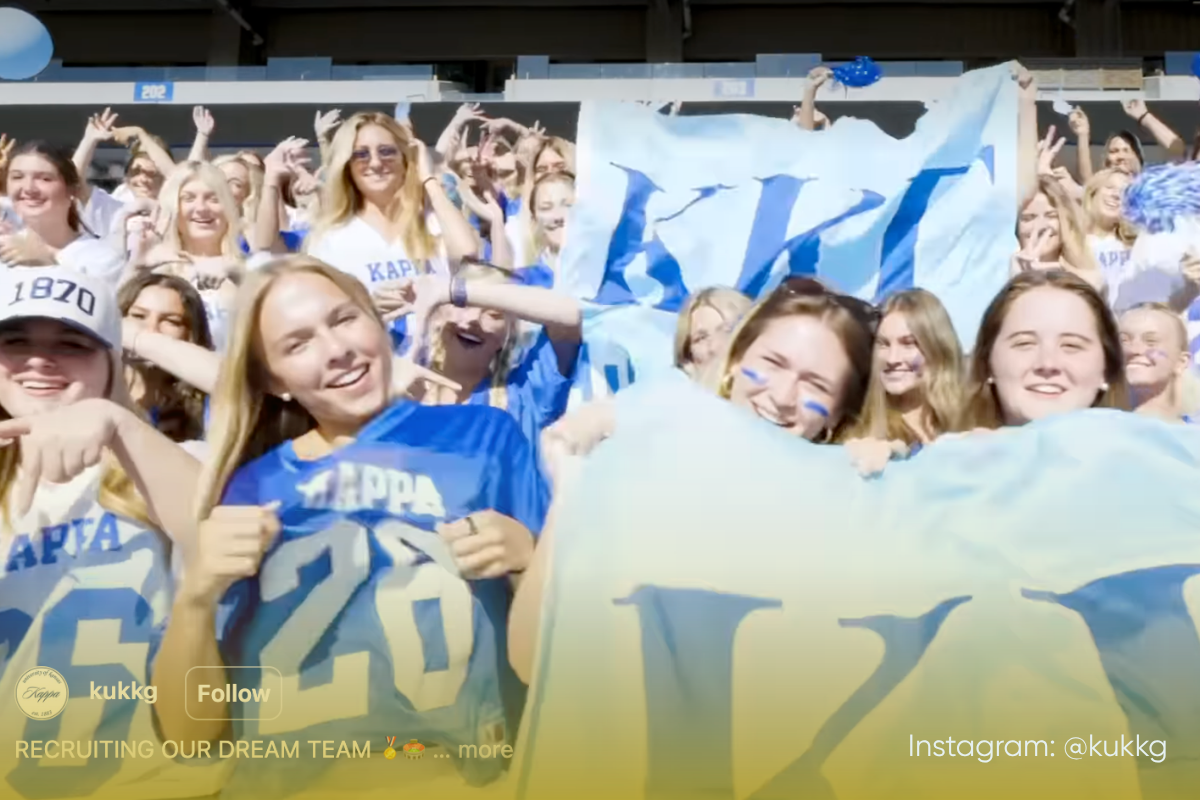
What started with relatively simple social media posts and videos has evolved into increasingly sophisticated productions. The coordinated dances in front of sorority houses are still there, but now chapters are also using elaborate themes, creative editing, campus landmarks, university mascots, basketball arenas, and football stadiums. Some of it is remarkably well done. This KU Kappa video is a far cry from my in-person mermaid acting!
These college women are content leaders and are essentially building mini creative agencies: developing concepts, organizing dozens of people, choreographing, producing, editing, and distributing content, while figuring out how to distinguish their organization in an increasingly crowded feed.
And now national brands have noticed the audience, too.
This year, Nike got involved in recruitment at the University of Alabama, and other colleges, bringing a customization experience to Gamma Phi Beta and providing coordinated Nike apparel. Videographers were there to capture the content. Other consumer brands are finding their way into RushTok through products, partnerships, and experiences.
There is a strategic communications lesson to recognize for sororities and for all of us: our communications opportunity no longer ends with the people who show up. We tend to define the audience for an event by who's in the room. Increasingly, those are two very different things.
A campaign launch may have 200 attendees. A speech may have 500 people in the audience. A community event may attract 1,000 people.
But the potential audience is exponentially larger.
That's what I find so interesting about the evolution of recruitment. Content and channel strategy expanded the audience, and with it, expectations. A new bar has been set.
The creativity and production we're seeing today changes what audiences will expect tomorrow. Once the football stadium, the mascot, the professional editing, and the brand activation enter the picture, where do you go next?
Every time someone finds a more creative way to capture attention, the rest of us are communicating in a world where that new standard exists.
So, for strategic communicators, there are two questions to ask:
Who is your audience now?
What will it take to earn their attention next?
As we are learning from sorority women, the people in the room are only the beginning.
Bonus: